Anti Static Packaging Tray Manufacturer in Taiwan
WELL CHSIEN PLASTIC CO., LTD. is an anti static packaging tray manufacturer in Taiwan, providing custom thermoformed trays for electronic components, precision parts, and industrial handling applications. Our services cover product evaluation, material selection, mold development, sampling, and production.
An effective packaging tray must fit both the component and the process. Product dimensions, contact points, loading methods, storage conditions, and electrostatic control requirements all influence the final design.
Whether you are developing packaging for a new component or reviewing an existing tray, WELL CHSIEN can evaluate your drawings, samples, and specifications to discuss a suitable manufacturing approach.
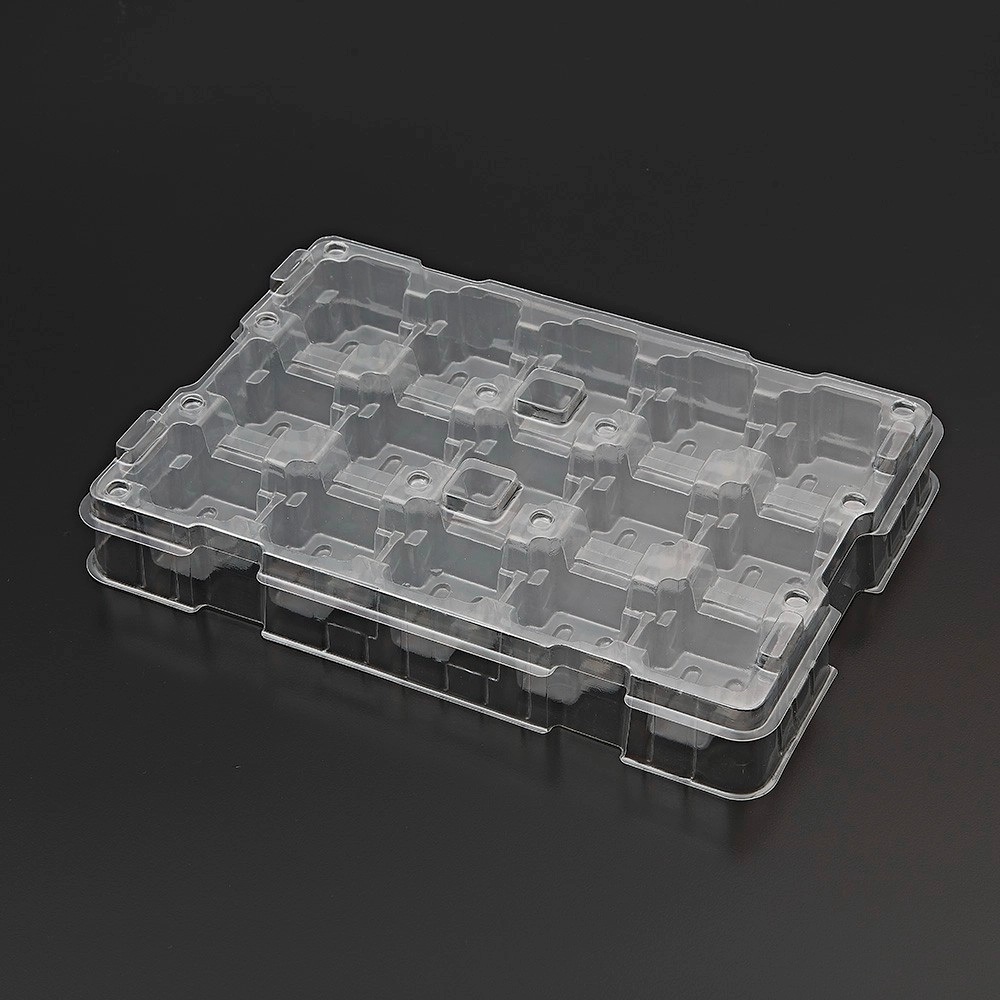 Clear antistatic packaging trays stacked together, featuring deep contoured pockets and raised component supports
This tray design features deep contoured pockets and raised supports to provide defined placement areas for individual components. As an anti static packaging tray manufacturer, WELL CHSIEN can evaluate cavity depth, contact points, and tray dimensions according to product drawings and handling requirements. Material properties should be specified for the intended application.
Custom Tray Manufacturing for Your Production Process
Standard trays do not always match the dimensions or handling requirements of a specific product. A custom thermoformed tray allows the cavity arrangement and outer dimensions to be developed around the actual application.
Individual pockets can separate components and maintain an organized layout. Access recesses can assist manual loading and removal, while positioning features can help establish a consistent orientation.
For buyers, the objective is to obtain packaging that works throughout the intended workflow—from loading and inspection to storage and transfer.
Explore our antistatic working trays for related product options.
| Manufacturing consideration | Information reviewed | Intended benefit |
|---|---|---|
| Component fit | Dimensions, tolerances, and product samples | Suitable cavity clearance and support |
| Tray layout | Part quantity, spacing, and orientation | Organized loading and inspection |
| Handling method | Manual loading or equipment interface | Practical access and positioning |
| Material selection | Electrical and mechanical requirements | Material suited to the application |
| Packaging arrangement | Covers, stacking, and outer boxes | Compatibility with the complete package |
| Production demand | Initial order and repeat quantities | Appropriate tooling and production planning |
Antistatic Properties and ESD Packaging Requirements
When selecting an anti static packaging tray manufacturer, define the required electrical properties before comparing products.
“Antistatic” generally describes a material’s ability to limit charge generation. Conductive and dissipative properties describe electrical resistance characteristics. Discharge shielding is a separate function involving protection against external electrostatic discharge.
These terms should be translated into measurable purchasing requirements. A request for an “ESD tray” alone may not give the manufacturer enough information to select a material.
The EOS/ESD Association’s principles of ESD control ↗ explain the importance of selecting packaging according to the handling environment, including additional shielding considerations when sensitive products leave an ESD protected area.
| Property | What it addresses | What buyers should specify |
|---|---|---|
| Antistatic / low charging | Charge generation during contact and separation | Intended use and relevant evaluation requirements |
| Static dissipative | Charge movement through a defined resistance range | Resistance limits and measurement method |
| Conductive | A relatively low-resistance electrical path | Required electrical characteristics and compatibility |
| Discharge shielding | External electrostatic discharge exposure | Performance of the complete packaging system |
A tray’s color or transparency does not establish its electrical performance. Confirm the material grade and supporting verification rather than relying on appearance.
For applications requiring conductive materials, review our conductive working trays.
Material Selection Based on Actual Operating Conditions
WELL CHSIEN works with vacuum forming materials including PET, PVC, PS, and PP. For antistatic packaging, the availability and suitability of a specific modified grade should be reviewed for each project.
Material selection should account for more than the resin name. The tray must also provide suitable rigidity, formability, and compatibility with the product and operating environment.
Buyers should identify whether the tray will be used once or repeatedly, whether transparent inspection is needed, and whether cleaning or elevated temperatures are involved.
| Requirement | Questions to resolve |
|---|---|
| Electrical performance | What limits, methods, and test conditions apply? |
| Component weight | Where should the tray support the load? |
| Temperature | What conditions will occur during use and storage? |
| Visibility | Must operators inspect parts through the tray? |
| Cleanliness | Are particles, residues, or particular additives restricted? |
| Reuse | How many handling cycles are expected? |
| Cleaning | What cleaning agents and procedures will be used? |
| Documentation | Which material declarations or test records are required? |
Do not assume that antistatic performance remains unchanged throughout every storage, cleaning, or reuse condition. Define the expected service conditions and confirm how the selected material will be evaluated.
Cavity Design for Component Protection and Access
Custom tray design should begin with the surfaces that can safely contact the component.
A housing may provide a suitable support area, while exposed leads, connectors, lenses, and cosmetic surfaces may require clearance. Excessive free movement can also create handling problems, so cavity clearance should balance positioning with easy removal.
For example, a shallow rectangular component may need finger recesses on opposing sides. A part with projecting terminals may require a support platform that keeps those terminals away from the tray floor.
Important design details include:
-
Component dimensions and tolerances.
-
Approved contact surfaces and restricted areas.
-
Cavity depth and spacing.
-
Loading direction and orientation.
-
Manual access or equipment clearance.
-
Loaded stacking height and cover clearance.
Our electronic work trays provide another starting point for discussing component handling applications.
Tooling, Sampling, and Production Approval
A clear development process helps connect the original specification with the finished tray.
WELL CHSIEN’s custom vacuum forming services include mold development, sampling, and manufacturing. Project requirements should be reviewed before tooling so that critical dimensions and acceptance criteria are understood.
A practical approval sequence includes:
-
Review product drawings, samples, and operating requirements.
-
Discuss material options and the proposed tray layout.
-
Confirm tooling scope and sample requirements.
-
Evaluate samples using actual components.
-
Approve the drawing, material specification, and inspection criteria.
-
Proceed with production according to the agreed requirements.
Sample approval should include component loading, removal, support, and stacking. Where trays interact with equipment, trials should address the actual interface rather than appearance alone.
Learn more about our vacuum formed products and broader tray product range.
Quality Requirements for Repeat Orders
For ongoing supply, buyers need a specification that can be applied consistently across repeat orders.
Agree on the approved material, drawing revision, dimensional requirements, and electrical acceptance criteria. Identify which characteristics are critical to product handling and which records are required with deliveries.
Electrical measurements should state the method and conditions used. Material data can support selection, but the verification plan should also address the finished tray where appropriate.
| Quality item | Recommended agreement |
|---|---|
| Drawing control | Approved dimensions, tolerances, and revision |
| Material control | Agreed resin grade and electrical properties |
| Fit verification | Approved sample and component loading criteria |
| Visual inspection | Acceptable forming, trimming, and surface condition |
| Electrical verification | Method, limits, conditions, and measurement locations |
| Order changes | Review process for material, tooling, or design changes |
| Documentation | Required inspection records and declarations |
If a project requires a particular certification or test report, confirm its scope and availability before placing the order.
Shipping Requires a Complete Packaging Review
A thermoformed tray provides positioning and separation, but shipping performance depends on the complete package.
Tray covers, outer cartons, cushioning, and any shielding enclosure should be evaluated together. An open antistatic tray should not automatically be treated as a discharge-shielding package.
The EOS/ESD Association’s packaging guidance ↗ provides background on packaging functions inside and outside an ESD protected area.
Tell the manufacturer whether the tray will remain within a controlled production area or travel through warehouses and external logistics. This distinction helps define the packaging requirements from the beginning.
Requesting a Quotation from an Anti Static Packaging Tray Manufacturer
A detailed inquiry allows the manufacturer to review technical feasibility and prepare a more useful quotation.
Provide drawings or samples together with expected quantities, ESD requirements, and the intended handling environment. If some requirements are flexible, identify them so that alternative layouts or materials can be discussed.
| RFQ information | Details to include |
|---|---|
| Product | Dimensions, weight, drawings, and samples |
| Tray size | Maximum outer dimensions and height |
| Layout | Number of cavities and preferred orientation |
| Electrical specification | Required properties, limits, and test method |
| Application | Assembly, inspection, storage, or transport |
| Quantity | Initial order and estimated repeat demand |
| Packaging | Covers, stacking, cartons, and shielding needs |
| Schedule | Requested sample and production delivery dates |
| Required records | Inspection reports or material documentation |
Tooling charges, minimum order quantity, sample timing, and production lead time depend on the agreed design and material. Request confirmation for the specific project.
FAQ: Anti Static Packaging Tray Manufacturing
1. What does an anti static packaging tray manufacturer need to begin a project?
A drawing or physical sample, expected quantity, intended use, and electrical requirements are useful starting points. Include tray size restrictions and any sensitive product surfaces.
2. Can trays be customized for different component shapes?
Custom thermoforming allows cavity layouts to be developed around different product geometries, subject to forming feasibility. Contact points, depth, spacing, and removal access should be reviewed during development.
3. Are antistatic and conductive trays the same?
They describe different properties. Antistatic refers to limiting charge generation, while conductive refers to electrical resistance characteristics. Specify the functions your application requires rather than treating the terms as equivalent.
4. Can an antistatic tray be transparent?
Transparent antistatic material options can be discussed, subject to material availability and the required performance. Transparency alone does not indicate whether a tray meets an electrical specification.
5. How should tray thickness be selected?
Thickness should be considered together with tray size, cavity depth, component weight, and stacking requirements. Forming changes the distribution of material, so the starting sheet thickness does not describe every area of the finished tray.
6. Can trays be used with automated equipment?
Submit the equipment interface requirements for review. Important details include tray dimensions, locating
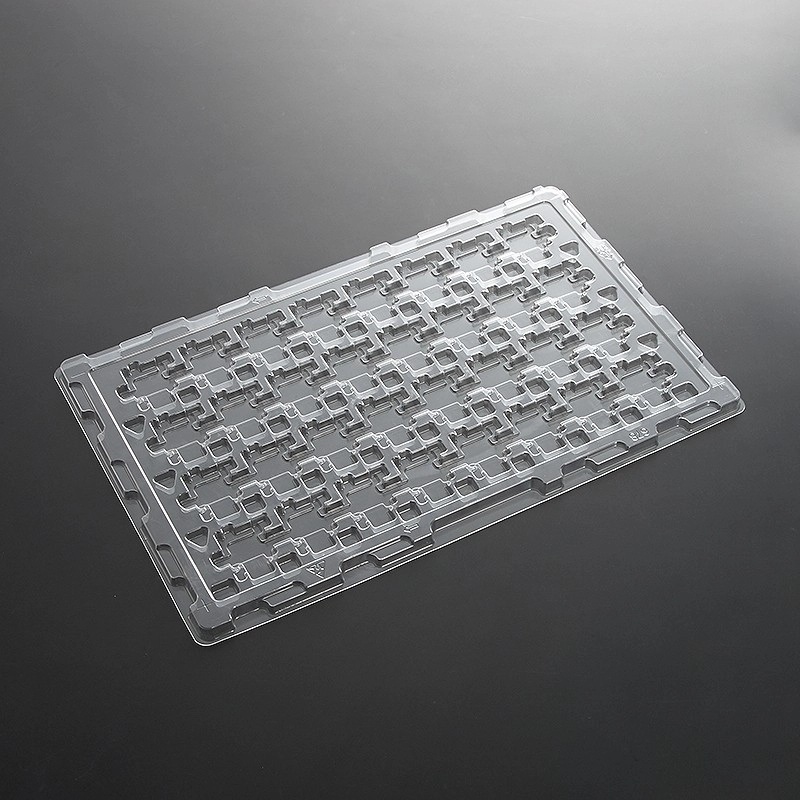 Clear antistatic packaging tray with closely spaced contoured cavities arranged in a regular grid
Closely spaced cavities provide an organized layout for small parts while keeping each component in a separate position. The shaped pockets can be developed around component geometry, orientation, and removal access. WELL CHSIEN reviews cavity spacing and overall tray dimensions to balance packing density with practical loading and inspection.
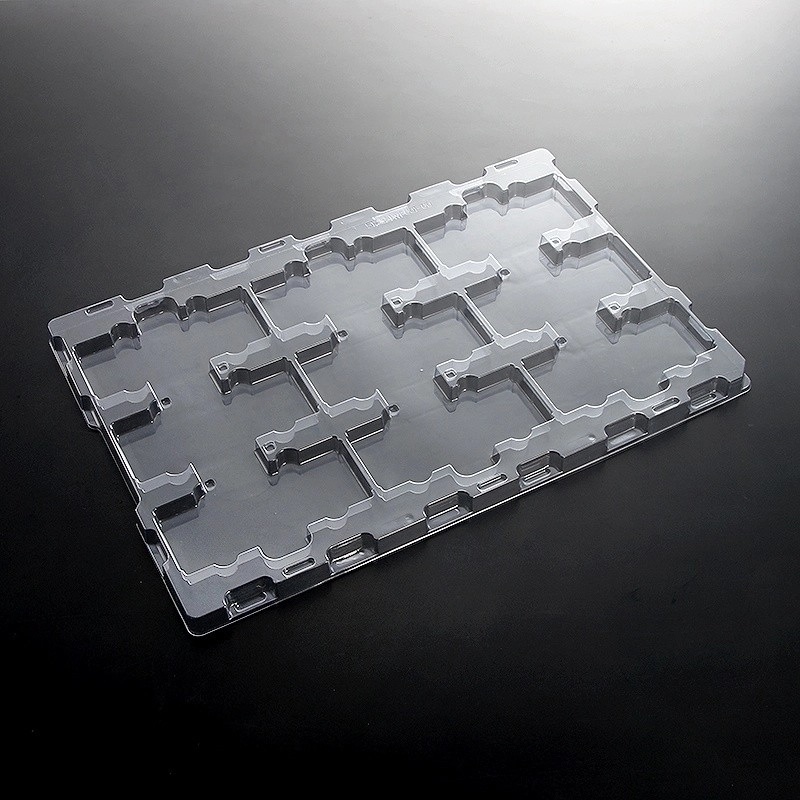 Clear antistatic packaging tray with large shaped cavities, raised dividers, and rounded access recesses
Large shaped cavities and raised dividers create defined spaces for components with wider profiles. Rounded recesses provide access around the cavity edges for manual handling. For custom manufacturing, WELL CHSIEN can review product tolerances, support locations, and clearance requirements to develop a tray layout suited to the intended workflow.
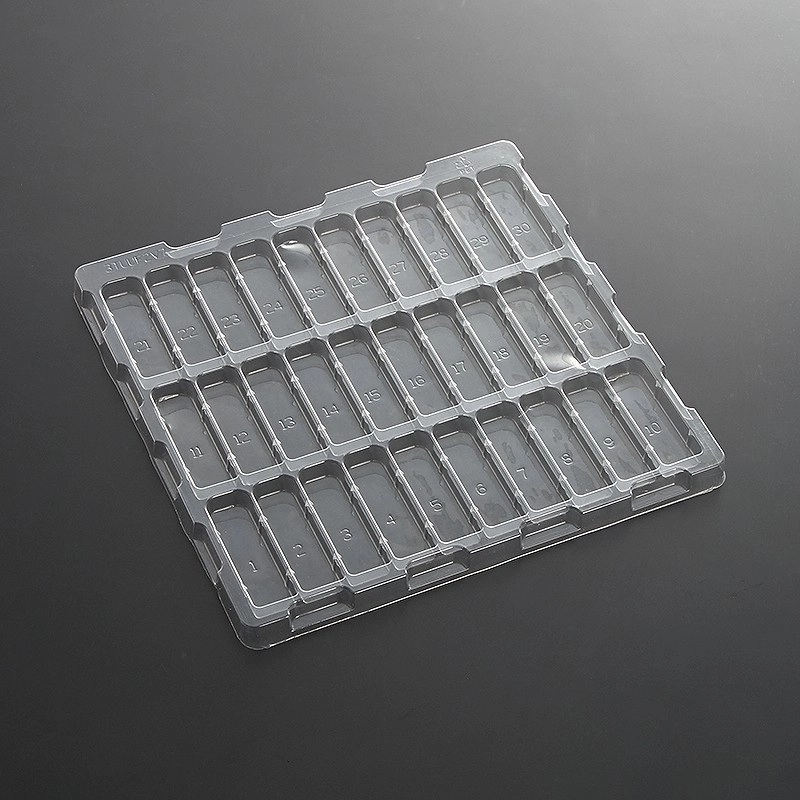 Clear antistatic packaging tray with 30 numbered rectangular cavities arranged in three rows
This 30-cavity tray features molded numbers that help operators identify individual positions during loading, counting, and inspection. Separate rectangular pockets maintain an orderly component arrangement. As an anti static packaging tray manufacturer, WELL CHSIEN can discuss cavity dimensions, numbering, and material requirements for your production and packaging process.