Custom ESD Blister Tray for Electronic Component Packaging
A custom ESD blister tray combines a component-specific cavity layout with material properties selected for the intended electrostatic control environment. For electronics manufacturers, the tray must do more than hold parts: it must support practical loading, stable positioning, inspection, storage, and movement through the production process.
WELL CHSIEN PLASTIC CO., LTD. is a Taiwan-based vacuum forming manufacturer offering custom plastic trays, antistatic trays, conductive trays, and thermoformed packaging. Projects can be evaluated using product drawings, physical samples, material requirements, and expected production quantities.
Whether your application involves electronic components, precision parts, or assembly work in progress, the starting point is the same: define how the product will contact the tray and where the complete packaging system will be used.
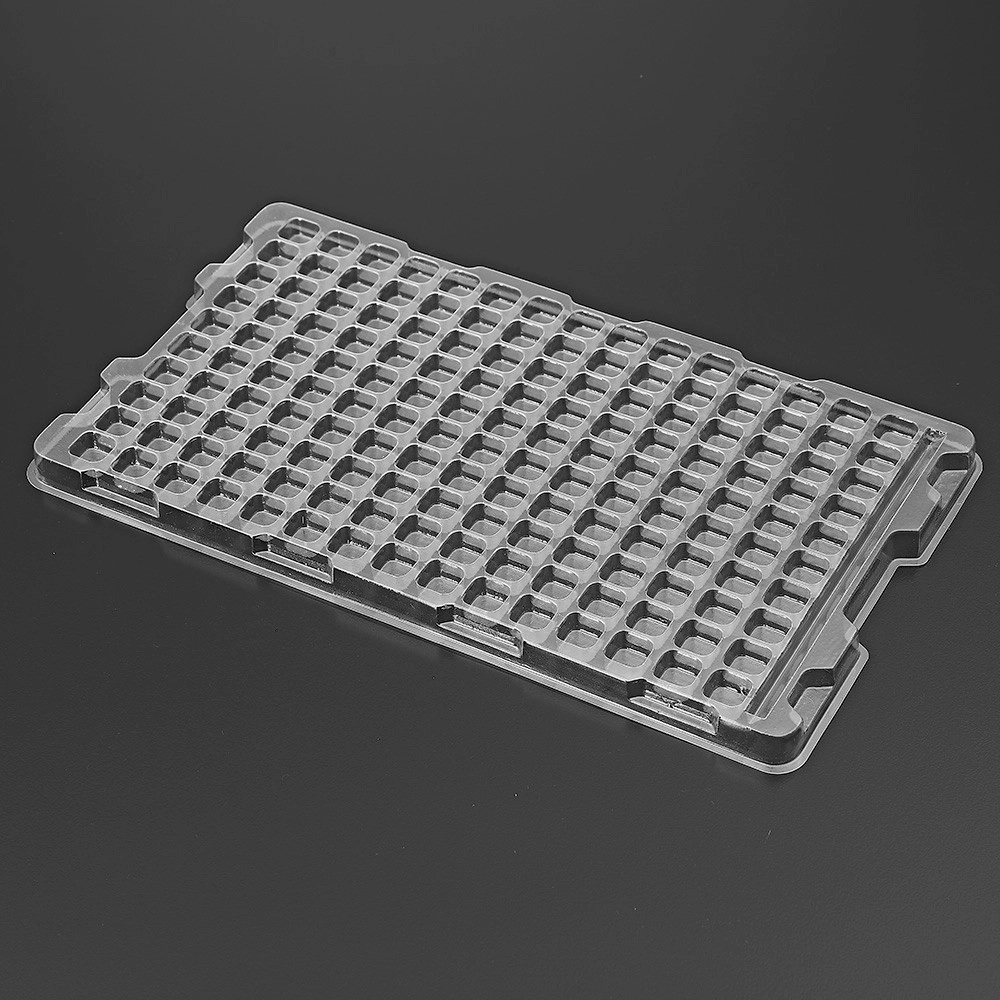 Custom ESD blister tray with a dense grid of small rectangular cavities for individual component placement
This custom ESD blister tray features a dense arrangement of individual cavities for organizing small components. Separate pockets help keep parts apart and maintain a consistent layout for counting, inspection, and handling. Cavity dimensions, spacing, and tray size can be discussed according to the component geometry and production requirements.
What Is a Custom ESD Blister Tray?
A custom ESD blister tray is a thermoformed plastic tray with cavities developed around the dimensions and handling requirements of specific components. Its electrical properties are selected and verified according to the application’s ESD control requirements.
In industrial packaging, “blister tray” commonly describes a formed tray with individual pockets. It does not necessarily mean a sealed retail blister pack.
Custom cavities can separate components, maintain their orientation, and limit unwanted movement. Finger access areas, support surfaces, and tray edges can also be considered during development.
The correct tray specification combines mechanical protection with appropriate electrostatic performance. A tray that fits well still needs suitable material properties, while an electrically suitable material still needs a practical cavity design.
For related industrial tray applications, explore our electronic work trays.
Antistatic, Dissipative, and Conductive Properties
ESD packaging terminology describes different functions. “Antistatic,” “dissipative,” “conductive,” and “shielding” should not be treated as interchangeable purchasing descriptions.
Antistatic generally refers to reducing charge generation. Dissipative and conductive properties concern electrical resistance and the movement of charge. Discharge shielding concerns protection against an external electrostatic discharge.
The EOS/ESD Association explains that packaging selection should consider low charging behavior, conductive or dissipative properties, and discharge shielding where required by the handling environment. Its ESD control principles ↗ provide useful background for defining a packaging specification.
| Property | Main function | Purchasing consideration |
|---|---|---|
| Low charging / antistatic | Limits charge generation during contact and separation | Evaluate the actual material interaction |
| Static dissipative | Allows charge to move through a defined resistance range | Specify the required range and test method |
| Conductive | Provides a relatively low-resistance electrical path | Confirm suitability for the component and process |
| Discharge shielding | Limits the effects of external electrostatic discharge | Evaluate the complete packaging structure |
Tray color alone does not establish any of these properties. A black tray should not be accepted as conductive without supporting verification.
Compare our antistatic working trays and conductive working trays when discussing your application.
Designing the Tray Around the Component
A useful custom tray starts with the product’s contact surfaces, sensitive features, and loading method.
For example, a component with exposed pins may need support beneath its housing and clearance around its terminals. A part with a cosmetic surface may require a different contact arrangement. For manual handling, operators need enough access to remove the component without forcing or bending it.
Important design questions include:
-
Which surfaces can safely contact the tray?
-
Which pins, leads, lenses, or finished surfaces need clearance?
-
How much movement is acceptable inside each cavity?
-
Will components be loaded manually or by equipment?
-
Must the tray maintain a fixed orientation?
-
Will loaded trays be stacked or covered?
Increasing cavity count can improve packing density, but the layout must also allow adequate support, separation, and access.
| Design feature | Purpose | What to confirm |
|---|---|---|
| Cavity dimensions | Accommodate the component | Product tolerances and required clearance |
| Support surfaces | Carry the component at suitable locations | Approved contact points |
| Finger access | Assist manual removal | Operator access and handling method |
| Orientation features | Help maintain loading direction | Component geometry and process needs |
| Stacking features | Separate loaded tray layers | Clearance above the tallest component |
| Tray perimeter | Interface with boxes or equipment | Outer dimensions and handling constraints |
Selecting Materials for a Custom ESD Blister Tray
Material selection should consider both forming performance and the required electrical properties.
WELL CHSIEN’s website lists PET, PVC, PS, and PP among its vacuum forming materials. For an ESD project, the suitability and availability of a particular antistatic or conductive grade should be confirmed individually. A base resin name alone does not establish ESD performance.
The selection process should address rigidity, tray depth, component weight, operating temperature, cleanliness, and expected service life.
If visual inspection through the tray is necessary, discuss transparency at the beginning of the project. If trays will be reused, include cleaning, abrasion, and repeated handling in the evaluation.
| Selection factor | Information to provide |
|---|---|
| Electrical properties | Required resistance range, test method, and acceptance criteria |
| Mechanical performance | Component weight, support needs, and stacking load |
| Temperature | Actual storage and operating conditions |
| Cleanliness | Particle, residue, and handling requirements |
| Visibility | Whether transparent packaging is needed |
| Service life | Single-use or reusable application |
| Additional restrictions | Customer-specific material or documentation requirements |
Avoid choosing a tray solely by appearance or sheet thickness. The finished geometry and material grade both influence performance.
Packaging Inside and Outside an ESD Protected Area
The location where a tray will be used affects the packaging requirements.
An ESD protected area, or EPA, provides controlled conditions for handling sensitive devices. When components leave that environment, the packaging system may also need discharge shielding.
An open antistatic or dissipative tray should not automatically be assumed to provide external discharge protection. Depending on the application, a suitable shielding bag or enclosure may be required around the tray.
The EOS/ESD Association’s packaging and material handling guidance ↗ explains this distinction.
Evaluate the tray, cover, outer packaging, and handling procedure together. Adding an ordinary plastic lid does not by itself establish shielding performance.
From Drawings and Samples to Production Approval
Custom tray development should connect the original requirements with an approved production sample.
Start by providing a drawing or physical component sample. The review can then address cavity layout, material options, tooling, sampling, and production requirements.
Before approving production, check the sample with actual components and the intended packaging arrangement. Confirm loading and removal, contact points, stacking clearance, and compatibility with boxes or handling equipment.
Electrical acceptance criteria should also be agreed before production. Define what will be measured, the test conditions, and what documentation is required. Sheet material information is useful, but it should not automatically replace verification relevant to the finished tray.
Learn more about our broader vacuum formed products and industrial tray range.
Information Needed for an Accurate Quotation
A quotation becomes more useful when the supplier understands the application as well as the dimensions.
Send the component drawing, expected quantity, tray layout preferences, and ESD specification together. Identify any requirements that are mandatory and any that can be adjusted during development.
| RFQ item | Recommended details |
|---|---|
| Component information | Drawings, samples, dimensions, weight, and sensitive features |
| Tray dimensions | Maximum length, width, height, and equipment constraints |
| Cavity layout | Preferred quantity, orientation, and spacing |
| ESD requirements | Electrical limits, test method, conditions, and required records |
| Handling environment | EPA use, storage, external transport, or customer delivery |
| Stacking | Loaded stack height, cover requirements, and clearance |
| Order quantity | Initial order and estimated repeat demand |
| Schedule | Sample approval date and requested delivery date |
| Documentation | Inspection reports or material declarations to be reviewed |
Minimum order quantity, tooling cost, sample timing, and production lead time depend on the agreed design and material. Confirm these items in the project quotation.
FAQ: Custom ESD Blister Tray
1. What is the difference between an ESD tray and a standard plastic tray?
A standard tray primarily provides mechanical positioning and separation. An ESD tray also uses specified electrical properties appropriate to the application. Similar shape or color does not mean two trays provide equivalent electrostatic performance.
2. Can the tray be designed from a physical sample?
A physical sample can support the initial design review. Drawings remain useful for communicating tolerances, critical surfaces, and areas that must not contact the tray. Confirm the information needed before tooling begins.
3. What resistance range should I specify?
Use the requirements established by your ESD control program and the applicable packaging specification. Include the measurement method and test conditions. A resistance value without this context can be difficult to interpret or compare.
4. Does a conductive blister tray provide discharge shielding?
Conductive material alone does not prove that the complete package provides adequate shielding. Tray geometry, openings, covers, and outer packaging must be considered. Verify the complete packaging arrangement for the intended environment.
5. Can a custom tray be used for shipping?
It can form part of a shipping package when the mechanical and ESD requirements are addressed. Evaluate component movement, tray stacking, cushioning, outer packaging, and any required shielding together.
6. Can ESD trays be reused?
Reuse depends on the material, tray condition, contamination limits, cleaning process, and continuing electrical performance. Establish inspection and verification criteria before using trays in a returnable packaging system.
7. Can a tray be developed for automated handling?
Automation requirements can be submitted for feasibility review. Provide equipment interface dimensions, positioning references, loading direction, cavity pitch, and tray separation requirements. Approval should include trials with the actual equipment where necessary.
8. Are ESD properties permanent?
Do not assume permanence from a product description alone. Performance can depend on the material system and service conditions. Ask how storage, humidity, cleaning, abrasion, and repeated use affect the selected grade.
9. What determines the price?
Price depends on tray dimensions, cavity geometry, material grade, thickness, tooling, order quantity, inspection, and documentation requirements. Agreeing on essential requirements early helps make supplier quotations more comparable.
10. What should I send to start a project?
Send a drawing or sample, intended tray dimensions, order quantity, handling environment, and ESD requirements. Include any deadlines and required test records so that technical and commercial requirements can be reviewed together.
Discuss Your Custom ESD Blister Tray Requirements
WELL CHSIEN provides custom vacuum forming and thermoformed packaging development for industrial applications.
If you need a custom ESD blister tray, share your component drawings or samples, expected quantities, and electrostatic control requirements. Material selection, cavity design, tooling, and sample approval can then be discussed around your actual production and packaging needs.
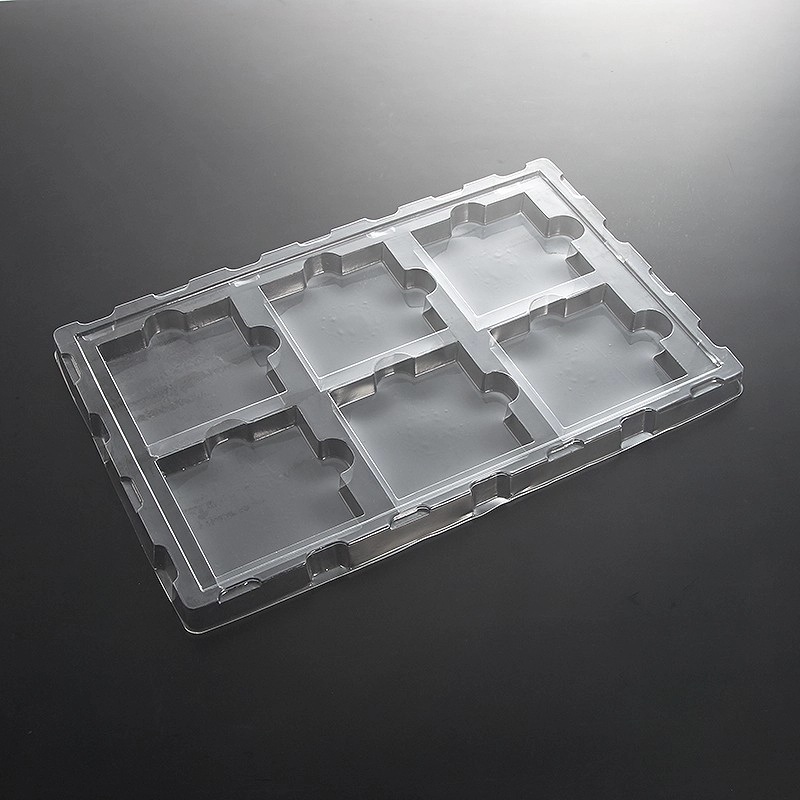 Clear custom ESD blister tray with six square cavities and rounded finger access recesses
Designed with six spacious cavities, this custom ESD blister tray provides separate positions for individual parts. Rounded access recesses allow operators to reach the edges of each component during loading and removal. The cavity layout can be evaluated around product dimensions, suitable contact surfaces, and the intended handling process.
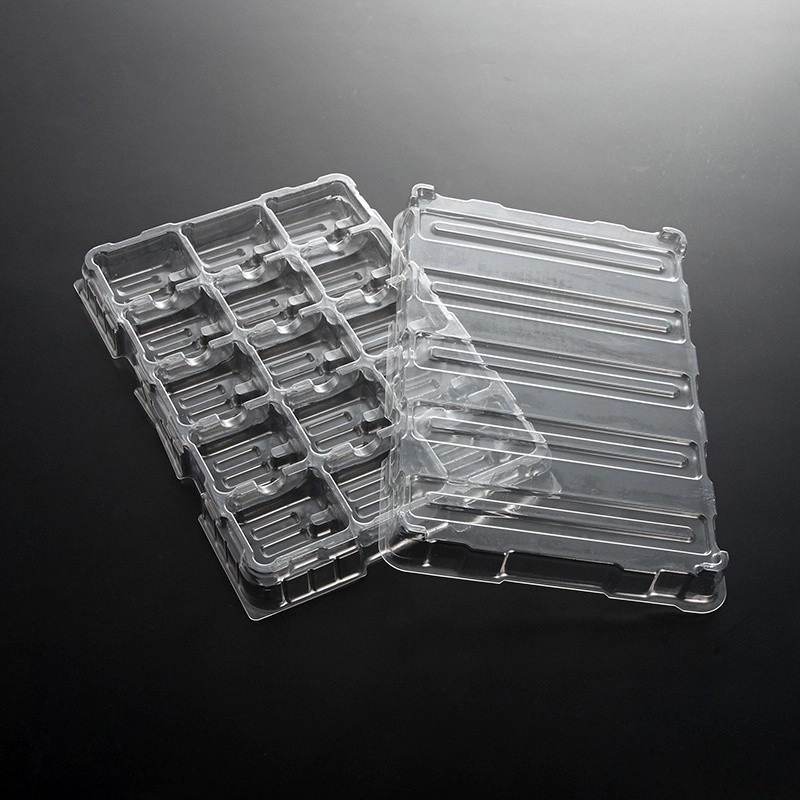 Clear custom ESD blister tray with multiple rectangular pockets and a separate ribbed cover
This custom ESD blister tray and cover arrangement combines individual component pockets with a separate transparent top cover. The clear structure allows visual checks of the contents, while the compartment layout supports organized placement. Cover fit, component clearance, and material properties should be specified together for the intended packaging application.
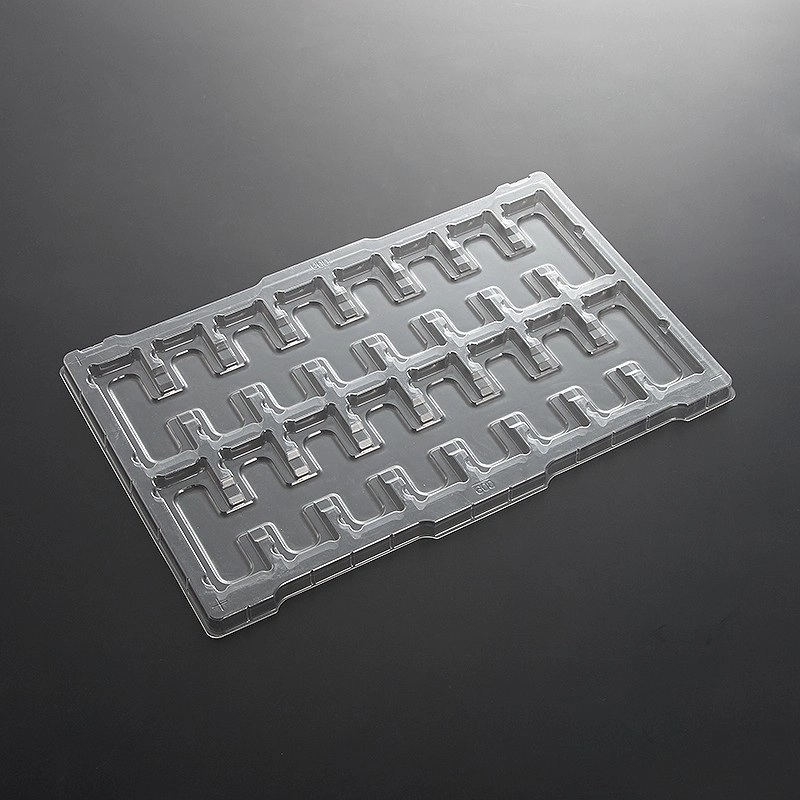 Clear custom ESD blister tray with two rows of contoured cavities and raised positioning features
This custom ESD blister tray uses contoured cavities and raised positioning features to accommodate specific part shapes. The layout provides defined placement areas that can help maintain component orientation during handling. Tray development should consider product tolerances, approved contact points, and sufficient clearance around sensitive features.