Cleanroom Blister Packaging Manufacturer: Custom Project Evaluation
Selecting a cleanroom blister packaging manufacturer starts with defining the cleanliness requirements of the product and its handling process. Packaging geometry, material selection, manufacturing conditions, and final packing all need to be considered before a supplier can confirm suitability.
WELL CHSIEN PLASTIC CO., LTD. provides custom vacuum forming and thermoformed packaging development in Taiwan. Our product range includes industrial trays, electronic component trays, packaging inserts, and selected medical-related plastic products.
For projects involving cleanroom use, submit your drawings, cleanliness specifications, and documentation requirements for feasibility review. Manufacturing environment classifications, cleaning services, testing, and final packing arrangements must be confirmed for the specific project.
 White thermoformed packaging tray with parallel elongated channels and raised dividers on a blue background
This white thermoformed tray features parallel channels for arranging elongated parts in separate positions. Custom development can address channel width, depth, and product contact areas. For buyers evaluating a cleanroom blister packaging manufacturer, WELL CHSIEN can review the tray design alongside specified material, cleanliness, and handling requirements.
What Does Cleanroom Blister Packaging Mean?
Cleanroom blister packaging generally refers to thermoformed packaging intended for use in a controlled environment or produced under specified contamination-control conditions.
These are different requirements. A tray intended to enter a customer’s cleanroom is not necessarily manufactured in a classified cleanroom. Similarly, production in a classified environment does not by itself establish the cleanliness of every finished package.
Buyers should define which operations require control, including forming, trimming, inspection, cleaning, handling, and bagging.
| Requirement | What it describes | What to confirm |
|---|---|---|
| Cleanroom manufacturing | The environment where specified operations occur | Classification, scope, and supporting records |
| Finished-product cleanliness | Contamination present on the supplied packaging | Limits, test methods, and acceptance criteria |
| Cleanroom compatibility | Suitability for the intended controlled environment | Material behavior and handling requirements |
| Controlled final packing | Protection after inspection or cleaning | Bagging method and transfer procedure |
| Sterile packaging | A separately validated sterility-related application | Sterilization and packaging validation requirements |
The ISO 14644-1 overview ↗ describes classification of air cleanliness by airborne particle concentration. This classification should not be presented as a finished-tray surface cleanliness result.
Custom Thermoformed Packaging Development
A cleanroom-related packaging project still needs a practical mechanical design. The tray must accommodate the product without creating unnecessary contact, abrasion, or handling difficulties.
WELL CHSIEN evaluates custom vacuum forming projects using product drawings, samples, material requirements, and expected quantities. Cavity layouts can be discussed around approved support areas, product orientation, and access for loading and removal.
For example, a precision component may need clearance around a polished surface while resting on a less sensitive housing area. A tray used with gloved hands may require more removal space than its external dimensions initially suggest.
Explore our vacuum formed products and industrial tray range for related manufacturing options.
Define Measurable Cleanliness Requirements
Terms such as “clean,” “dust-free,” and “cleanroom grade” are not sufficient purchasing specifications on their own.
Identify the contamination that matters to the product. Depending on the application, this may involve particles, chemical residues, fibers, or biological contamination. Each requires appropriate evaluation rather than a single general cleanliness claim.
For surface particles, the ISO 14644-9 overview ↗ provides a reference concerning assessment of surface cleanliness by particle concentration.
| Specification item | Information to provide |
|---|---|
| Contamination type | Particles, residues, fibers, or other defined contaminants |
| Critical surfaces | Product-contact areas or the entire tray |
| Acceptance limits | Numerical limits, units, and relevant particle sizes |
| Test method | Agreed sampling, extraction, or measurement procedure |
| Sampling plan | Sample quantity and lot acceptance rules |
| Test stage | Before packing, after cleaning, or at receipt |
| Documentation | Required reports and identification of tested samples |
Testing arrangements and available documentation should be agreed before tooling or production approval.
Material Selection for Controlled Environments
Material selection should reflect both packaging performance and the intended environment.
WELL CHSIEN’s vacuum forming materials include PET, PVC, PS, and PP. Suitability for a particular cleanroom-related application must be reviewed at the material-grade level.
A resin name alone does not establish low particle generation, low outgassing, chemical compatibility, or cleanliness. Additives, surface treatments, forming conditions, and subsequent handling may also matter.
| Material consideration | Questions to resolve |
|---|---|
| Mechanical performance | Will the tray support the product without excessive flexing? |
| Surface interaction | Could contact mark or abrade the product? |
| Chemical restrictions | Are particular additives or substances prohibited? |
| Cleaning compatibility | Is the grade compatible with the proposed cleaning process? |
| Temperature | What exposure temperature and duration are expected? |
| Electrical properties | Are antistatic or conductive characteristics required? |
| Material evidence | Which declarations or supporting data are needed? |
If electrical properties are required, review our antistatic working trays and conductive working trays. Electrical suitability and cleanliness must be assessed separately.
Cavity Design and Contamination-Sensitive Handling
Packaging design can influence how much contact occurs during loading, transport, and removal.
A cavity that is too tight may require force to release the product. Excessive clearance may allow movement and repeated contact. The appropriate balance depends on product tolerances, approved support locations, and handling conditions.
Design review should address:
-
Product surfaces that may contact the tray.
-
Sensitive areas requiring clearance.
-
Access for gloved hands or automated grippers.
-
Movement permitted within each cavity.
-
Trimmed edges near the product.
-
Contact between loaded tray layers.
-
Features that could complicate cleaning, where cleaning is required.
These considerations support design evaluation but do not replace cleanliness testing.
For electronic applications, see our electronic work trays.
Handling and Final Packing Requirements
A packaging specification should explain how cleanliness is maintained after the relevant production and inspection steps.
Customers may require protective bags, multiple bag layers, specified labels, or defined opening procedures. Such arrangements should be discussed individually and confirmed before ordering.
Double bagging, for example, is a packing configuration rather than proof of a particular cleanliness level.
| Packing consideration | Required agreement |
|---|---|
| Tray quantity per pack | Handling practicality and exposure during use |
| Protective bags | Material, dimensions, and closure method |
| Multiple bag layers | Customer transfer and opening procedure |
| Labels | Location, identification, and material restrictions |
| Outer cartons | Protection and separation from controlled-area contents |
| Storage | Conditions and limits supported by the agreed specification |
Confirm which operations the supplier will perform and which remain part of the customer’s incoming preparation process.
Cleanroom Packaging and Sterile Packaging
Cleanroom requirements and sterility requirements must be evaluated separately.
A tray intended for cleanroom use is not automatically sterile. A formed tray or ordinary cover also does not automatically constitute a validated sterile barrier system.
For medical applications, identify whether the tray is a handling aid, protective insert, or part of the final sterile packaging system. The intended role determines which additional requirements need review.
The FDA’s overview of medical device sterilization ↗ explains that sterilization involves specific processes and validation considerations.
WELL CHSIEN’s medical packaging products provide a starting point for product discussions. Any required manufacturing controls, sterilization compatibility, or regulatory documentation must be confirmed separately.
Supplier Qualification and Sample Approval
When evaluating a cleanroom blister packaging manufacturer, request evidence that matches the actual purchasing requirement.
A general company certificate should not be treated as proof that every production operation occurs within a classified cleanroom. Similarly, a sample’s visual appearance cannot establish particle or residue compliance.
A practical qualification process includes:
-
Define the intended use and mandatory requirements.
-
Confirm the supplier’s relevant capabilities and operating scope.
-
Review material information and the proposed tray design.
-
Agree on sampling and acceptance criteria.
-
Evaluate product fit and handling.
-
Complete the required cleanliness assessments.
-
Approve packing instructions and documentation before production.
Where a mandatory requirement cannot be supported, resolve it before approving the supplier for that application.
Request a Custom Packaging Review
A detailed inquiry helps establish whether the project can be supported and what additional qualification is required.
| RFQ item | Recommended details |
|---|---|
| Product | Drawings, samples, dimensions, and weight |
| Intended use | Cleanroom entry, internal handling, or final packaging |
| Environment | Applicable classification and controlled operations |
| Cleanliness | Limits, test methods, and critical surfaces |
| Material | Preferred grade and prohibited substances |
| Electrical needs | Required properties and verification criteria |
| Packing | Bags, labels, quantities, and transfer instructions |
| Quantity | Initial order and expected repeat demand |
| Documentation | Required certificates, reports, and records |
| Schedule | Qualification, sample approval, and delivery dates |
WELL CHSIEN can review these requirements alongside tooling and production feasibility. MOQ, development costs, testing arrangements, and lead time should be confirmed in the project quotation.
FAQ: Cleanroom Blister Packaging
1. Does “cleanroom packaging” always mean manufactured in a cleanroom?
No. The phrase may describe intended use or production conditions. Specify where each operation must occur and what evidence is required.
2. Does an ISO cleanroom classification establish finished-tray cleanliness?
No. Air cleanliness classification and finished-product surface cleanliness concern different measurements. Define the product acceptance criteria separately.
3. Which material is best for cleanroom trays?
There is no universally suitable resin. Evaluate the specific grade against mechanical, chemical, electrical, and cleanliness requirements.
4. Can an antistatic tray be used in a cleanroom?
Possibly, subject to qualification. Antistatic performance does not establish particle, residue, or other cleanliness characteristics.
5. Is cleanroom blister packaging sterile?
Not automatically. Sterility requires separate processes and evidence appropriate to the intended application.
6. Can trays be washed before use?
A cleaning process may be considered after material compatibility and the required cleanliness outcome are defined. Confirm who performs cleaning and how its effectiveness is verified.
7. Does double bagging guarantee cleanliness?
No. It can support a defined transfer procedure, but bagging alone does not establish the cleanliness of the contents.
8. Can tray geometry be customized?
Custom layouts can be evaluated using product drawings and samples. Contact areas, removal access, and cleaning considerations should be included in the design review.
9. What documentation should buyers request?
Request records relevant to the specification, such as material information, environmental classification evidence where required, inspection results, and agreed cleanliness reports. Confirm availability before ordering.
10. How should a project with WELL CHSIEN begin?
Submit the product geometry, intended use, cleanliness limits, manufacturing environment requirements, quantity, and required documentation. The project can then be reviewed for feasibility before any cleanroom-related capability is committed.
Discuss Your Cleanroom Packaging Requirements
WELL CHSIEN provides custom vacuum forming and thermoformed packaging development in Taiwan.
If you are evaluating a cleanroom blister packaging manufacturer, share your technical specification for review. Confirming cleanliness, manufacturing conditions, and qualification requirements early helps establish a clear basis for supplier selection and sample approval.
Contact WELL CHSIEN to discuss your custom packaging requirements.
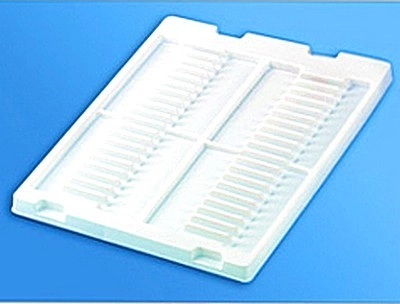 White rectangular packaging tray with four sections of narrow parallel grooves and a raised outer rim
Four sections of narrow grooves provide an organized layout for separating and positioning small parts. The raised perimeter surrounds the loading area, while the central dividers define individual sections. Tray dimensions and groove spacing can be evaluated against product samples, with any cleanroom-related requirements confirmed during project review.
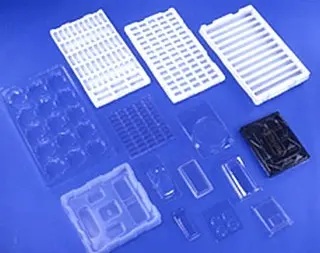 Assorted white, clear, and black thermoformed packaging trays with channels, grids, and shaped cavities
This product selection illustrates different thermoformed packaging structures, including channel trays, grid layouts, and contoured inserts. WELL CHSIEN evaluates custom designs around product geometry and handling needs. When selecting a cleanroom blister packaging manufacturer, buyers should also confirm the required production environment, finished-product cleanliness, and protective packing arrangements.