Electronic Component Packaging Tray Supplier in Taiwan
WELL CHSIEN PLASTIC CO., LTD. is an electronic component packaging tray supplier in Taiwan, offering custom vacuum-formed trays for component organization, handling, storage, and transport.
Our services include product evaluation, material selection, mold development, sampling, and production. Tray designs can be reviewed using customer drawings, physical samples, electrical requirements, and expected order quantities.
Choosing a packaging tray involves more than matching external dimensions. The tray must accommodate sensitive features, provide suitable support, and work within the customer’s production and logistics processes.
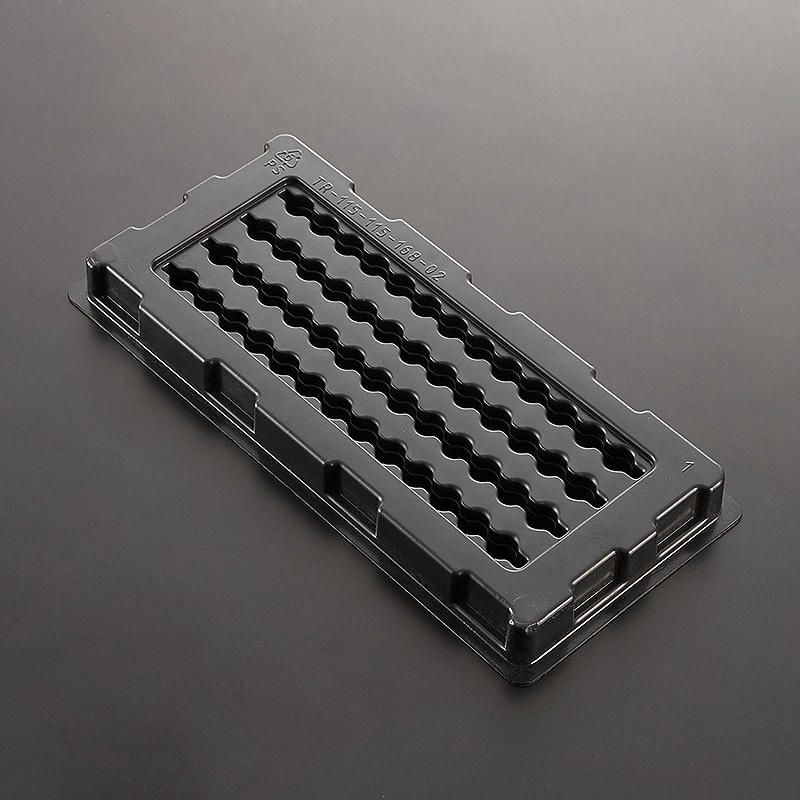 Black electronic component packaging tray with parallel rows of scalloped cavities and a raised outer frame
This black thermoformed tray features closely spaced scalloped cavities for organizing small components in consistent rows. The shaped layout provides defined placement positions while separating neighboring parts. As an electronic component packaging tray supplier, WELL CHSIEN can evaluate cavity dimensions, spacing, and contact areas according to customer drawings and samples.
Custom Packaging Trays for Electronic Parts
Electronic components vary in shape, weight, surface finish, and handling sensitivity. A standard cavity may fit the overall dimensions while contacting a terminal, connector, or other feature that needs clearance.
Custom thermoformed trays allow the cavity arrangement to be developed around the actual product. Separate pockets can maintain an organized layout and limit contact between neighboring parts.
WELL CHSIEN evaluates tray requirements for electronic parts and industrial applications. Depending on the project, the review may address cavity geometry, loading orientation, manual access, stacking, and material properties.
Explore our electronic work trays for related product options.
| Product characteristic | Packaging consideration |
|---|---|
| Small rectangular housing | Cavity clearance and removal access |
| Round component body | Pocket diameter, depth, and support |
| Projecting terminals | Clearance around exposed features |
| Irregular outline | Contoured positioning surfaces |
| Cosmetic or optical surface | Restrictions on tray contact |
| Multiple product versions | Compatibility checks for each version |
The final design should be approved with representative products rather than judged from an empty tray alone.
Matching the Tray to the Handling Process
A tray used for manual assembly may need different features from one used for automated loading or customer delivery.
For manual operations, operators need access to approved gripping areas. Automated equipment may require specific outer dimensions, positioning references, cavity pitch, and empty-tray separation behavior.
Storage and shipping introduce additional requirements, including loaded stacking, component retention, and compatibility with outer packaging.
| Process stage | Tray requirement | Approval check |
|---|---|---|
| Loading | Suitable access and orientation | Parts enter without excessive force |
| Inspection | Consistent component positions | Relevant features remain accessible |
| Assembly transfer | Stable placement | Parts remain in the intended positions |
| Storage | Practical stacking | Upper layers avoid sensitive components |
| Automated handling | Equipment compatibility | Trials with the actual interface |
| Shipping | Complete packaging compatibility | Loaded package evaluation |
Tell the supplier how the tray will be used at every stage. A design approved for one operation may need further review before being introduced into another.
Material Options and Electrical Requirements
WELL CHSIEN’s vacuum forming materials include PET, PVC, PS, and PP. The appropriate grade depends on the required mechanical, electrical, and environmental performance.
For ESD-sensitive components, specify the electrical properties needed by your ESD control program. A resin name, tray color, or generic “ESD-safe” description is not a complete material specification.
Antistatic generally refers to reduced charge generation. Conductive and dissipative properties concern electrical resistance. Discharge shielding addresses a separate packaging function.
The EOS/ESD Association’s principles of ESD control ↗ explain how material properties and handling controls work together.
| Material requirement | Information to confirm |
|---|---|
| Mechanical support | Component weight and tray loading |
| Electrical properties | Required limits, units, and test method |
| Transparency | Whether inspection through the tray is necessary |
| Temperature | Actual storage and operating conditions |
| Cleanliness | Particle, residue, and additive restrictions |
| Chemical exposure | Cleaning agents and contact conditions |
| Reuse | Expected service life and inspection criteria |
Review our antistatic working trays and conductive working trays when discussing electrical requirements.
Cavity Design, Access, and Packing Density
A higher cavity count may reduce the number of trays needed, but packing density should be balanced with support, separation, and removal access.
For example, closely spaced pockets may work for small components loaded by equipment. The same arrangement may be difficult to use manually if operators cannot reach the intended gripping surfaces.
During design review, identify:
-
The product’s dimensional tolerances.
-
Approved support and contact locations.
-
Features that must remain clear of the tray.
-
Required loading direction.
-
Manual or automated gripping areas.
-
Acceptable movement within each pocket.
-
Space needed between loaded tray layers.
Where appropriate, position markings or orientation features can also be discussed. Their usefulness should be checked within the actual workflow.
From Product Information to an Approved Sample
A clear development process helps buyers and suppliers establish the same expectations before production.
WELL CHSIEN supports mold development, sampling, and vacuum forming production. The project review begins with the product and its intended application.
A practical sequence is:
-
Submit drawings, samples, quantities, and application requirements.
-
Review material options and cavity layout.
-
Confirm critical dimensions and acceptance criteria.
-
Agree on tooling scope and sample requirements.
-
Evaluate samples with actual components.
-
Approve the material, drawing revision, and inspection requirements.
-
Proceed with the agreed production order.
Sample approval should address loading, removal, contact points, and loaded stacking. Electrical verification should follow the agreed specification where required.
If the component changes during development, identify the revision before approving tooling or production.
Selecting an Electronic Component Packaging Tray Supplier
A useful supplier comparison considers technical scope and repeat-order requirements alongside unit price.
Provide each supplier with the same product information, material requirements, quantity, and inspection criteria. This makes it easier to identify differences in the quotations.
| Supplier evaluation item | What to establish |
|---|---|
| Design review | Information required and feasibility review scope |
| Material selection | Grade availability and supporting information |
| Tooling | Charges, ownership, maintenance, and modification terms |
| Sampling | Sample quantity, approval process, and revision costs |
| Production | Agreed dimensions, material, and inspection criteria |
| Documentation | Available records and any additional charges |
| Delivery | Schedule, packing method, and shipment terms |
| Repeat supply | Reorder quantities and change notification arrangements |
Minimum order quantities and lead times should be confirmed for the specific design. Avoid comparing prices where the tooling, material, or verification scope differs.
Repeat Orders and Specification Control
For ongoing purchasing, retain an approved specification that connects the product drawing, tray design, material, and sample reference.
This provides a basis for reviewing repeat orders and proposed changes. A different material grade, cavity adjustment, or trim dimension may affect handling even when the tray appears similar.
Before reordering, confirm:
-
The approved tray drawing and revision.
-
The agreed material grade.
-
Required inspection and electrical criteria.
-
Order quantity and packing arrangement.
-
Delivery expectations.
-
Any changes to the packaged component.
Where traceability or particular inspection records are required, agree on their scope before ordering.
Shipping, Shielding, and Outer Packaging
The tray is one part of the packaging system.
An open antistatic or conductive tray should not automatically be assumed to provide discharge shielding. For ESD-sensitive products moving outside a controlled area, the complete package may require a suitable shielding enclosure.
Likewise, cavity fit alone does not establish shipping performance. Covers, cushioning, cartons, and loaded stacking should be evaluated together.
Tell the supplier whether the tray will remain inside a production facility, move between factories, or be shipped to customers. These routes can involve different handling and packaging requirements.
Information Needed for a Quotation
A complete inquiry helps an electronic component packaging tray supplier review feasibility and prepare a meaningful quotation.
| RFQ item | Recommended details |
|---|---|
| Product information | Drawings, samples, dimensions, weight, and revision |
| Sensitive features | Terminals, connectors, surfaces, and contact restrictions |
| Tray layout | Cavity quantity, orientation, and size constraints |
| Material requirements | Mechanical and electrical specifications |
| Handling process | Manual loading or equipment interface |
| Packaging arrangement | Covers, stacking, cushioning, and outer carton |
| Quantity | Initial order and estimated repeat demand |
| Schedule | Requested sample approval and delivery dates |
| Documentation | Required declarations, inspection records, or test reports |
WELL CHSIEN can review these details to discuss custom tooling and production requirements. Learn more about our vacuum formed products and industrial tray range.
FAQ: Electronic Component Packaging Tray Supply
1. Can a tray be developed from a physical component sample?
A physical sample can support the initial evaluation. Drawings are also useful for identifying tolerances, critical dimensions, and surfaces that must not contact the tray.
2. What types of cavity shapes can be considered?
Rectangular, circular, and contoured layouts can be evaluated according to product geometry and forming feasibility. Depth, spacing, and removal access should be reviewed together.
3. Are all electronic component trays ESD protective?
No. Electrical performance depends on the selected material and packaging design. Specify the required properties and verification criteria rather than relying on appearance.
4. Can the supplier recommend a material?
Material options can be discussed based on the application. Buyers should provide operating conditions and mandatory requirements so that suitability can be reviewed.
5. Can one tray accommodate several component versions?
Possibly, but every version should be checked for fit, support, and clearance. Similar outer dimensions do not guarantee compatibility.
6. Can trays be designed for automated loading?
Submit equipment interface dimensions, positioning references, cavity pitch, and gripping requirements for feasibility review. Sample approval should include equipment trials where necessary.
7. What determines the minimum order quantity?
MOQ depends on the material, tray design, tooling, and production requirements. Confirm the applicable quantity in the project quotation.
8. How long does sampling take?
Timing depends on design review, material availability, tooling, and approval requirements. Ask for separate estimates for tooling, sampling, and production.
9. Can trays be reused?
Reuse depends on physical condition, cleanliness, and continuing electrical performance where applicable. Define cleaning, inspection, and replacement criteria for the intended process.
10. What should be confirmed before a repeat order?
Confirm the approved drawing revision, material, quantity, inspection requirements, and delivery schedule. Notify the supplier of any component changes that could affect tray fit.
Discuss Your Electronic Component Packaging Requirements
WELL CHSIEN provides custom thermoformed tray development and production support for electronics and industrial applications.
Send your drawings or samples to discuss cavity layout, material options, tooling, and order requirements. Defining the application and acceptance criteria early provides a clear basis for sample approval and repeat purchasing.
Contact WELL CHSIEN to discuss your electronic component packaging tray project.
 Black packaging insert with three elongated contoured cavities and one rectangular accessory compartment
This custom packaging insert combines three contoured cavities with a separate rectangular compartment for arranging products and accessories. The layout illustrates how different shapes can be accommodated within one tray. Cavity depth, support surfaces, and removal clearance can be reviewed to suit the actual contents and packaging requirements.
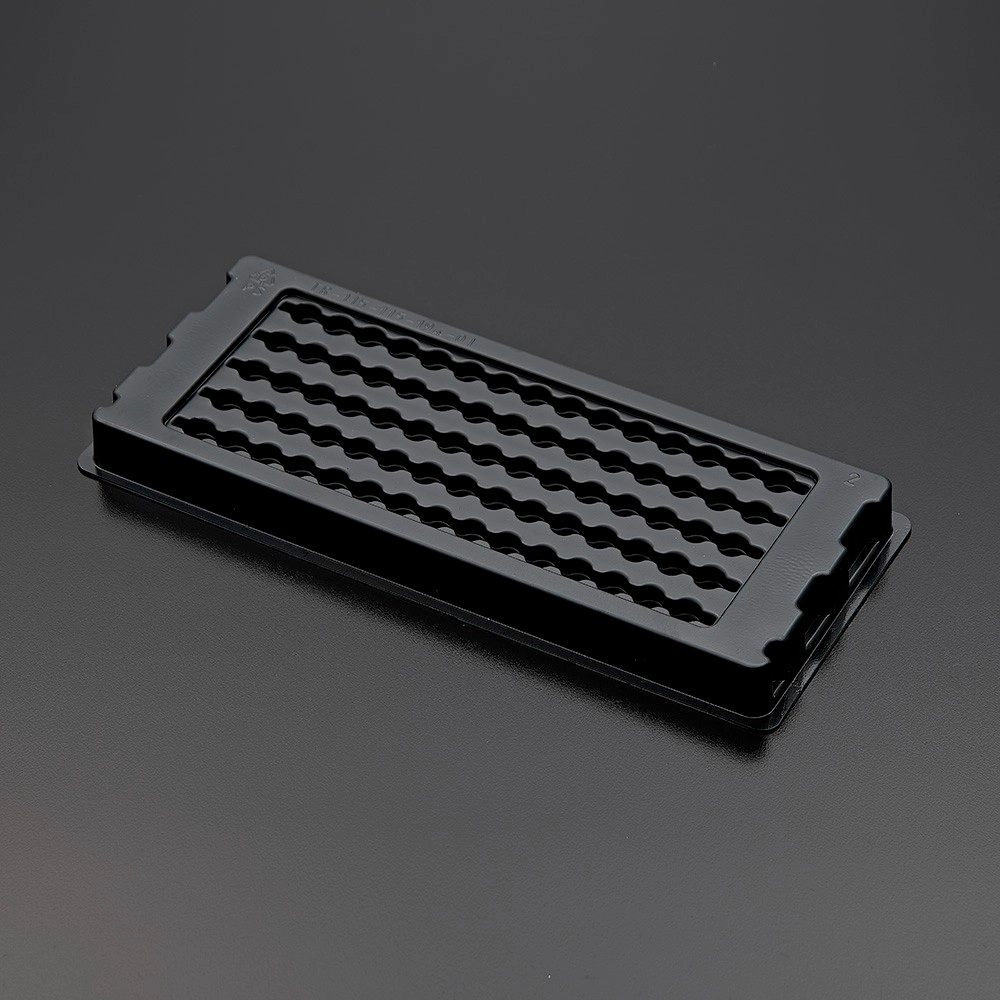 Rectangular black electronic component tray with multiple rows of scalloped pockets and molded edge markings
Multiple rows of scalloped pockets create an orderly layout for component placement, counting, and inspection. The raised perimeter surrounds the cavity area, with molded markings visible along the edge. WELL CHSIEN supplies custom electronic component packaging trays with layouts evaluated around part geometry, handling access, and overall tray dimensions.