Anti-Static Thermoformed Clamshell Packaging
An anti-static thermoformed clamshell combines a hinged packaging structure with material properties selected to reduce electrostatic charging during handling. Custom cavities provide designated positions for products, while the attached cover helps keep the packaging components together.
WELL CHSIEN PLASTIC CO., LTD. provides custom vacuum forming and thermoformed packaging development in Taiwan. Our product range includes folded boxes, packaging inserts, electronic work trays, antistatic trays, and conductive trays.
For an anti-static clamshell project, the structure and material should be evaluated together. Product fit, hinge behavior, closure force, handling conditions, and electrical requirements all influence the final specification.
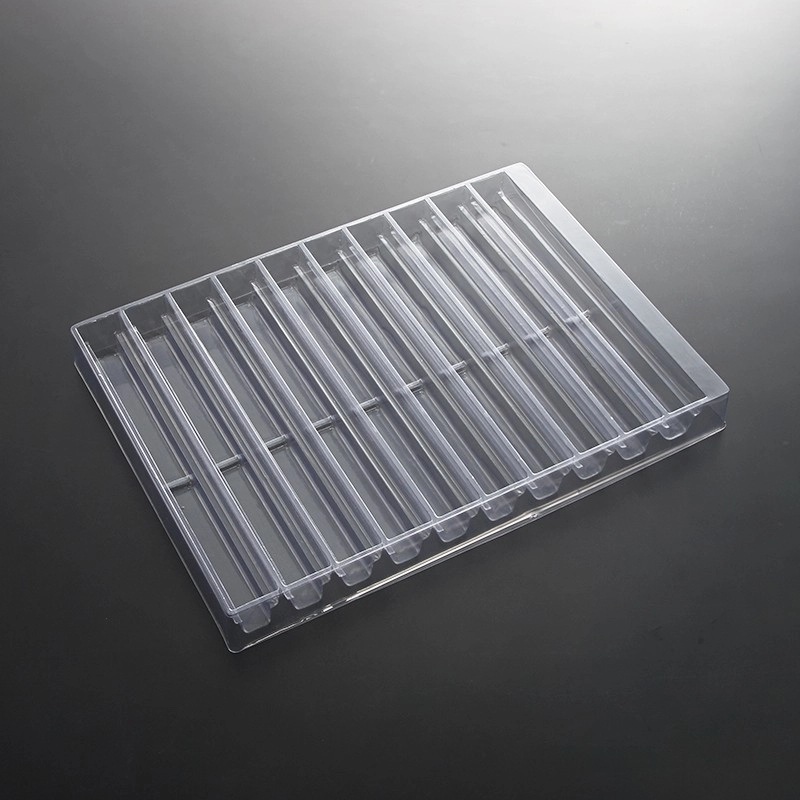 Clear thermoformed tray with parallel elongated channels, raised dividers, and a rectangular outer rim
Parallel channels provide separate placement areas for elongated parts. Channel width, depth, and support locations can be reviewed against the actual product. For an anti-static thermoformed clamshell project, a similar cavity layout can be evaluated alongside the hinged cover, closure, and required material properties.
What Is an Anti-Static Thermoformed Clamshell?
A thermoformed clamshell is a plastic package with two sections connected by a formed hinge. One section typically holds the product, while the other folds over it to create a cover.
Depending on the design, the two sections may use matching cavities, a deeper base with a shallow cover, or separate spaces for products and accessories.
An anti-static version requires a suitable material system and verification appropriate to the application. The hinged shape itself does not provide anti-static performance.
Explore our folded box packaging for related custom packaging structures.
| Structural element | Function | Design consideration |
|---|---|---|
| Base cavity | Positions the product | Fit, support, and removal access |
| Cover | Encloses the loading area | Clearance above the product |
| Hinge | Connects the two sections | Folding behavior and intended service life |
| Closure features | Keep the package closed | Engagement and opening force |
| Perimeter flange | Provides an edge around the package | Handling, trimming, and closure geometry |
| Access tabs | Assist opening | Finger access and operator usability |
When to Consider a Clamshell Instead of an Open Tray
A clamshell can be useful when the packaging requires an attached cover or when products and accessories need to remain together in one package.
An open tray may be more practical for repeated access on an assembly line. A separate tray and lid may suit a different loading or stacking process. The appropriate format depends on how the product moves through packing, inspection, storage, and delivery.
| Packaging format | Potential application | What to evaluate |
|---|---|---|
| Hinged clamshell | Product packaging with an attached cover | Hinge, closure, and opening access |
| Open tray | Frequent loading and removal | Component access and loaded stacking |
| Tray with separate lid | Covered handling or storage | Lid identification, fit, and retention |
| Packaging insert | Positioning within an outer box | Compatibility with the complete package |
WELL CHSIEN can review the proposed format using product drawings, samples, and handling requirements. See our packaging inserts and industrial tray range for related options.
Custom Cavities for Product Positioning
The cavity should support the product at approved locations without placing unnecessary pressure on sensitive features.
For example, an electronic module may be supported beneath its housing while requiring clearance around exposed connectors. A package containing accessories may need separate pockets to prevent contact between the main product and smaller parts.
The cover must also be considered. A product that fits comfortably in an open base may contact the upper section once the clamshell is closed.
During design review, identify:
-
Product dimensions and tolerances.
-
Approved support and contact surfaces.
-
Sensitive features requiring clearance.
-
Clearance above and below the product.
-
Loading direction and removal method.
-
Spaces needed for accessories.
-
Acceptable movement after closure.
Approve samples with actual products inside the closed package. Visual inspection of the empty clamshell is not enough to establish fit.
Hinge Design and Opening Requirements
The hinge connects the base and cover, but its performance depends on the selected material and formed geometry.
A package intended to be opened once has different requirements from one intended for repeated access. If reuse is required, define the expected number of opening and closing cycles and the conditions under which they occur.
The hinge should also allow the cover to align with the base without forcing the product out of position.
| Hinge requirement | Information to provide |
|---|---|
| Intended use | Single-use packaging or repeated opening |
| Opening cycles | Expected frequency and acceptance criteria |
| Opening angle | Space needed for loading and removal |
| Alignment | Required positioning between base and cover |
| Operating conditions | Temperature and handling environment |
| Inspection | Acceptable appearance and functional condition |
Material selection should not be based on transparency or price alone when hinge durability is important.
Closure Features and Product Clearance
A closure should keep the package engaged during the intended handling process while remaining practical to open.
Snap features, edge engagement, and opening tabs can be evaluated according to forming feasibility and product requirements. Excessive closing force may make packing difficult, while insufficient retention may allow unintended opening.
Closure testing should use the intended loading method and representative products. Confirm that engaging the closure does not compress components or bend the packaged item.
A snap-closed clamshell is not automatically hermetic, tamper evident, or moisture protective. These functions require separate design and validation where needed.
Anti-Static Properties and ESD Protection
Anti-static, dissipative, conductive, and discharge-shielding properties describe different packaging functions.
Anti-static generally concerns reduced charge generation during contact and separation. Dissipative and conductive properties concern electrical resistance. Discharge shielding addresses exposure to external electrostatic discharge.
The EOS/ESD Association’s principles of ESD control ↗ explain why packaging selection should account for both the product and the handling environment.
| Property | Main purpose | Specification requirement |
|---|---|---|
| Anti-static / low charging | Reduce charge generation | Relevant material interactions and evaluation criteria |
| Dissipative | Provide a controlled resistance path | Limits, units, and measurement method |
| Conductive | Provide a relatively low-resistance path | Application suitability and electrical requirements |
| Discharge shielding | Limit external discharge effects | Verification of the complete packaging structure |
Closing a clamshell does not automatically make it a shielding enclosure. For ESD-sensitive products transported outside an ESD protected area, evaluate whether additional shielding packaging is required.
Related material options can be discussed through our antistatic working trays and conductive working trays.
Selecting Materials for the Application
WELL CHSIEN’s vacuum forming materials include PET, PVC, PS, and PP. The suitability and availability of a particular anti-static grade should be confirmed for each project.
A base resin name does not establish electrical performance, hinge life, or compatibility with the product. The material grade and forming requirements should be reviewed together.
If transparent packaging is needed, state this at the beginning of the project. Transparency should be assessed alongside stiffness, surface contact, closure behavior, and the electrical specification.
Other requirements may include:
-
Storage and operating temperatures.
-
Cleanliness or residue restrictions.
-
Compatibility with labels or additional packing materials.
-
Expected storage duration.
-
Cleaning requirements for reusable packaging.
-
Required material declarations.
Do not assume that anti-static properties are permanent under all storage, humidity, cleaning, and handling conditions. Confirm the expected service conditions and verification requirements.
Sampling and Performance Verification
Sample approval should evaluate the clamshell as a loaded package.
WELL CHSIEN supports custom tooling, sampling, and production development. Before sampling, agree on the characteristics that determine acceptance.
| Verification item | What to check |
|---|---|
| Product fit | Loading, positioning, and removal |
| Contact points | Clearance around sensitive features |
| Closed-package clearance | No unintended pressure from the cover |
| Hinge behavior | Alignment and agreed opening cycles |
| Closure | Practical engagement and retention |
| Electrical performance | Agreed limits, methods, and conditions |
| Packing compatibility | Fit within outer cartons or shielding packaging |
Where electrical measurements are required, identify the property being measured and the relevant units. Surface resistance and surface resistivity should not be treated as interchangeable measurements.
Agree on sampling, test locations, and reporting requirements before production approval.
Shipping and Outer Packaging
An anti-static thermoformed clamshell provides product organization and enclosure, but shipping performance depends on the complete package.
Review cushioning, carton fit, orientation, stacking, and any required shielding enclosure together. Where transport qualification is required, establish a test plan appropriate to the distribution route and customer requirements.
A package that remains closed during manual handling may behave differently under vibration, impact, or compression. Evaluate the loaded arrangement rather than relying on closure feel alone.
Custom Development with WELL CHSIEN
A clear project specification helps connect the original requirements with tooling, sample approval, and repeat production.
Provide product drawings or physical samples, intended quantities, and electrical requirements. Identify which dimensions are final and which may change during development.
| RFQ item | Recommended information |
|---|---|
| Product | Drawings, samples, dimensions, and weight |
| Cavity layout | Product orientation and accessory positions |
| Contact restrictions | Approved supports and sensitive surfaces |
| Hinge | Intended opening frequency and service conditions |
| Closure | Retention, opening access, and packing method |
| Material | Transparency, electrical properties, and restrictions |
| Logistics | Outer packaging, stacking, and shipping route |
| Quantity | Initial order and expected repeat demand |
| Documentation | Required inspection and material records |
| Schedule | Sample approval and requested delivery dates |
Tooling charges, minimum order quantity, sample timing, and production lead time should be confirmed for the agreed design.
Learn more about our custom vacuum formed products.
FAQ: Anti-Static Thermoformed Clamshell Packaging
1. What makes a clamshell anti-static?
The selected material system and its verified properties determine anti-static performance. The shape, color, or transparency of the package does not establish its electrical characteristics.
2. Can an anti-static clamshell be transparent?
Transparent options can be discussed, subject to material availability and the required performance. Confirm the specific grade and supporting information before approval.
3. Does a closed clamshell provide ESD shielding?
Not automatically. Low charging behavior and discharge shielding are different functions. Evaluate the complete packaging system against the intended ESD requirements.
4. Can the package be opened and closed repeatedly?
Repeated use may be possible, but hinge and closure performance require evaluation. Define the expected cycles and operating conditions during development.
5. Can one clamshell hold a product and its accessories?
Separate cavities can be evaluated for different contents. Provide the dimensions, loading arrangement, and contact restrictions for every item.
6. Can the closure prevent accidental opening?
Closure retention can be designed and tested for the intended application. Confirm the required performance through sample and package testing rather than assuming a snap fit will suit every transport condition.
7. Is thermoformed clamshell packaging waterproof or airtight?
An ordinary hinged clamshell should not be assumed to provide either function. Moisture protection, sealing, and barrier requirements need separate evaluation.
8. What determines material thickness?
Thickness depends on package dimensions, cavity depth, product weight, stiffness, hinge behavior, and closure design. Evaluate the finished sample alongside the starting sheet specification.
9. Can the clamshell accommodate electronic assemblies?
Feasibility depends on the assembly profile and contact restrictions. Provide clearance requirements around components, terminals, and connectors, including features beneath the product.
10. What is needed for a quotation?
Send product drawings or samples, expected quantities, cavity requirements, electrical specifications, and intended opening and shipping conditions. Include documentation and delivery requirements for a complete review.
Discuss Your Anti-Static Clamshell Project
WELL CHSIEN provides custom thermoformed packaging development in Taiwan.
Share your product drawings or samples to discuss cavity layout, hinge design, closure, material options, and production requirements. An agreed specification provides the basis for sample evaluation and repeat orders.
Contact WELL CHSIEN to discuss anti-static thermoformed clamshell packaging.
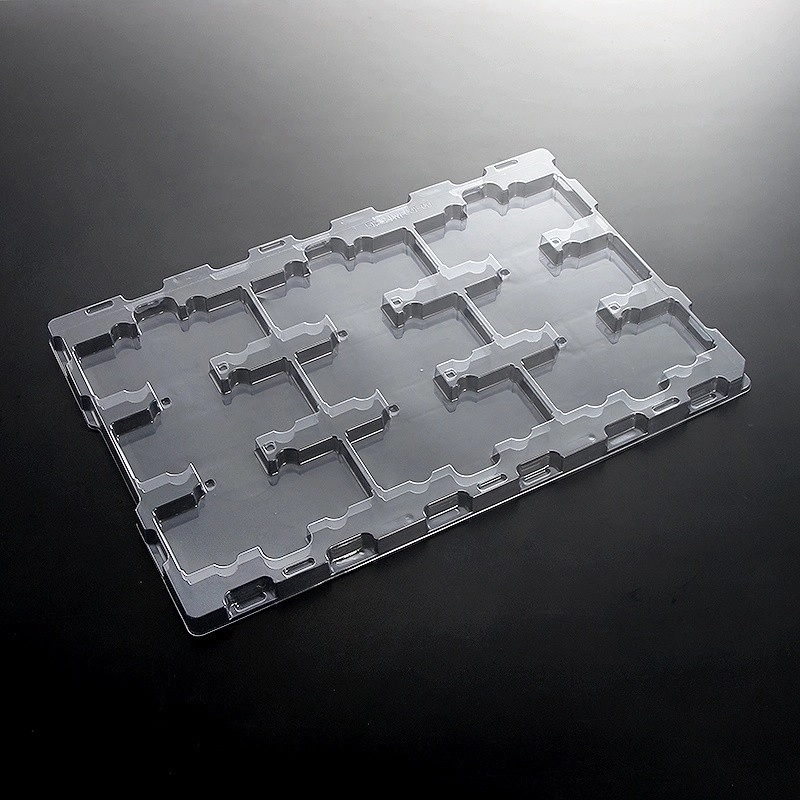 Clear thermoformed packaging tray with contoured cavities, raised positioning features, and rounded access recesses
Contoured cavities and raised positioning features define individual product locations, while rounded recesses provide access around the edges. This design illustrates cavity features that can be considered during custom packaging development. Any clamshell configuration should also be evaluated for cover clearance and product movement after closure.
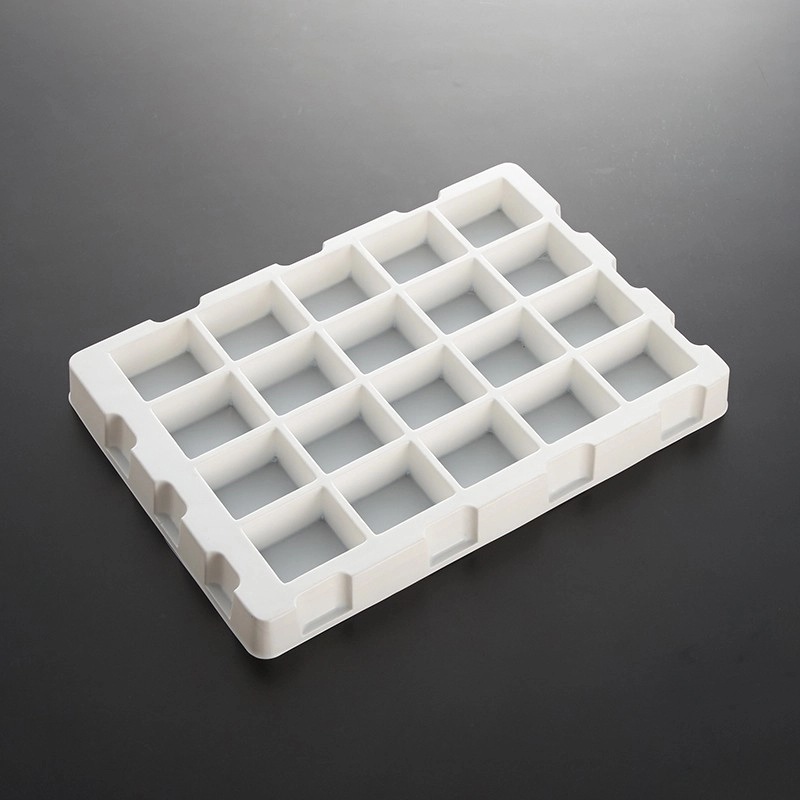 White rectangular packaging tray with a grid of deep square compartments and raised dividing walls
Deep square compartments keep individual parts separated in an organized grid. Custom compartment dimensions can be discussed according to product size, loading access, and handling requirements. For anti-static thermoformed clamshell packaging, the compartment layout and upper cover must be developed together to maintain suitable clearance around the contents.
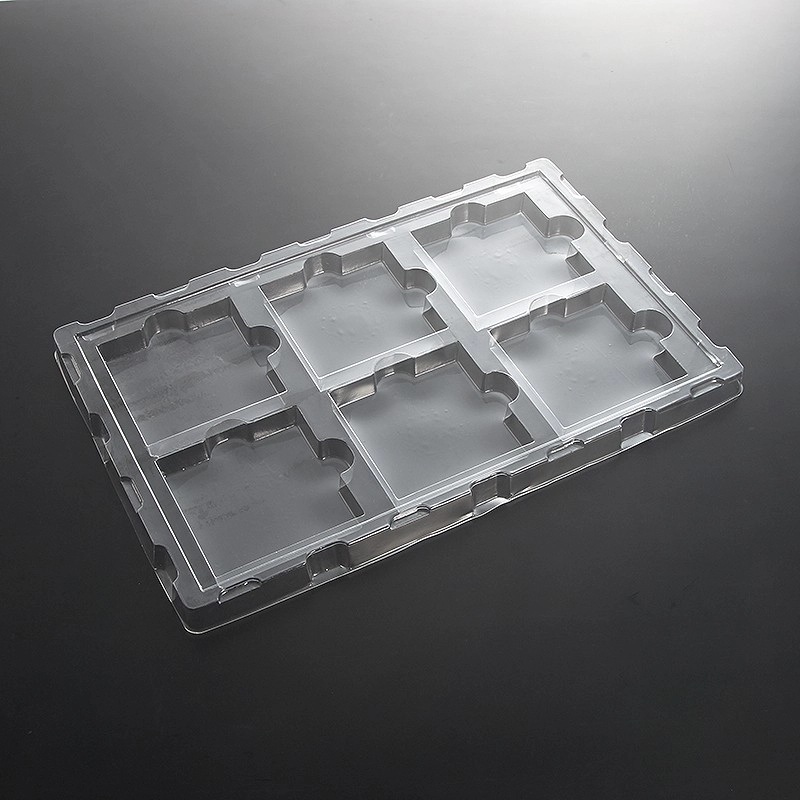 Clear thermoformed tray with six square cavities, rounded finger access recesses, and a raised perimeter
Six individual cavities provide defined placement areas, with rounded finger recesses to assist loading and removal. The transparent structure allows visual inspection of the contents. WELL CHSIEN can review similar cavity arrangements for custom packaging projects, with anti-static materials, hinge design, and closure requirements evaluated separately.